
Views: 0 Author: Site Editor Publish Time: 2025-07-18 Origin: Site
Creating your own acrylic lamp base combines the satisfaction of DIY craftsmanship with the modern elegance of custom lighting. Whether you're looking to add a personal touch to your home decor or start a small lighting business, making an acrylic lamp base offers endless creative possibilities while being surprisingly achievable for beginners.
Acrylic has become the material of choice for modern lamp bases due to its crystal-clear transparency, exceptional durability, and remarkable versatility. Unlike traditional glass, acrylic won't shatter into dangerous pieces, making it safer for home workshops and family environments. Its lightweight nature also makes it easier to handle during construction, while its excellent light transmission properties create stunning visual effects when paired with LED lighting.
This comprehensive guide will walk you through every step of creating your own acrylic lamp base, from initial design concepts to the final assembly. You'll learn professional techniques, troubleshoot common issues, and discover advanced customization options that will set your creations apart.
Acrylic offers several compelling advantages over traditional lamp base materials like wood, ceramic, or metal. First, its optical clarity rivals that of glass, allowing light to pass through with minimal distortion. This creates brilliant illumination effects and makes colors appear more vibrant.
The material's impact resistance is roughly 10 times greater than glass, making it virtually shatterproof under normal use. This durability extends to temperature resistance as well - acrylic maintains its structural integrity across a wide temperature range, making it safe for use with various lighting technologies.
From a crafting perspective, acrylic excels in workability. It cuts cleanly with both manual and power tools, accepts engraving beautifully, and can be shaped with heat. The material also bonds well with various adhesives, allowing for strong, nearly invisible joints in your finished lamp base.
When compared to wood lamp bases, acrylic won't warp, crack, or fade over time. Unlike metal bases, it won't corrode or require special treatments to maintain its appearance. These properties make acrylic an ideal choice for both beginners and experienced craftspeople.
Success in making an acrylic lamp base depends heavily on having the right tools and materials. Here's what you'll need for a professional-quality result:
Materials:
Acrylic sheet (1/4" to 1/2" thick for structural components)
LED light strips or modules (choose based on desired color and brightness)
Electrical wire (18-22 gauge, appropriate for your LED voltage)
Power supply or adapter (matching your LED requirements)
UV-resistant acrylic cement or epoxy adhesive
Felt pads or rubber feet for the base
Essential Tools:
Laser cutter or fine-tooth saw for cutting acrylic
Drill with various bit sizes
Dremel rotary tool with engraving bits
Soldering iron and solder
Wire strippers
Sandpaper (220-400 grit)
Safety equipment (glasses, gloves, dust mask)
Optional but Helpful:
Heat gun for shaping (use with extreme caution)
Clamping system for assembly
Measuring tools and square
Protective film or masking tape
The quality of your tools will directly impact your results. Invest in sharp, clean cutting tools to achieve smooth edges that require minimal finishing. A steady drill press will create cleaner holes than a handheld drill, though both can work with practice.
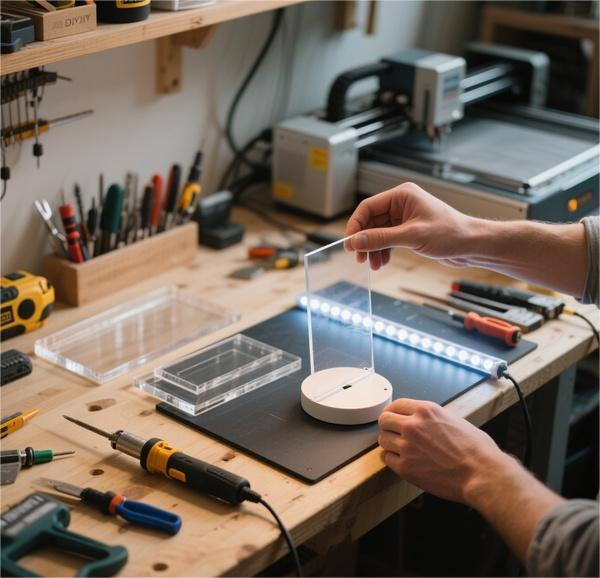
Begin by sketching your lamp base design on paper, considering both aesthetic appeal and structural stability. Simple geometric shapes like rectangles, circles, or hexagons work well for beginners, while more complex organic shapes can create stunning effects for advanced makers.
Use design software like Adobe Illustrator, Fusion 360, or even free alternatives like Inkscape to create precise technical drawings. This step is crucial if you plan to use a laser cutter, as most require vector-based files for optimal results.
Consider the proportions carefully - your base should be wide enough to provide stability but not so large that it overwhelms the room. A good rule of thumb is to make the base approximately 1/3 the height of your finished lamp.
If using a laser cutter, set your parameters according to your acrylic thickness. Most 1/4" acrylic cuts well at moderate speeds with multiple passes. Always test cut a small piece first to dial in your settings.
For manual cutting, use a fine-tooth saw and cut slowly to prevent chipping. Score-and-snap methods work well for straight cuts in thinner acrylic, but thicker pieces require power tools.
After cutting, sand all edges with 220-grit sandpaper, progressing to 400-grit for a smooth finish. This step is essential for both appearance and safety, as sharp acrylic edges can be dangerous.
Plan your electrical routing carefully before drilling. LEDs require power connections, and hiding these wires contributes significantly to a professional appearance.
For edge-lit designs, route a channel along the inside edge of your base to accommodate LED strips. This channel should be slightly wider than your LED strip to allow for easy installation and potential future maintenance.
Drill mounting holes for your LED components, ensuring they're positioned to provide even light distribution. Use a drill press if available, and work slowly to prevent cracking.
LED strips are the most popular choice for acrylic lamp bases due to their flexibility and even light distribution. When selecting LEDs, consider color temperature (warm white for cozy ambiance, cool white for task lighting) and whether you want single-color or color-changing options.
Measure your LED strips carefully and cut only at designated cutting points, usually marked every few LEDs. Most strips have adhesive backing, but additional mechanical fastening may be necessary for permanent installations.
Solder your connections carefully, using heat shrink tubing to protect joints. Poor electrical connections are a common source of failure in DIY lighting projects.
Use high-quality acrylic cement for invisible joints, or clear epoxy for stronger bonds. Work in a well-ventilated area and allow adequate curing time before handling.
Assemble your base in stages, testing the fit of each component before applying adhesive. Once bonded, acrylic joints are very difficult to separate without damage.
Before final assembly, test your electrical system thoroughly. Check for proper operation, even light distribution, and any potential hot spots that might indicate poor connections.
Use a Dremel rotary tool or laser engraver to create custom patterns in your acrylic. Light will scatter beautifully through engraved areas, creating stunning visual effects. Start with simple geometric patterns before attempting complex artwork.
Chemical etching or fine sandblasting can create frosted areas that diffuse light beautifully. This technique works particularly well for creating subtle patterns or logos in your lamp base.
While clear acrylic showcases LED colors most effectively, tinted acrylic can create sophisticated color effects. Consider using different colored acrylic layers to create depth and visual interest.
Modern LED controllers can add color-changing capabilities, remote control operation, and even smartphone app integration. These features transform a simple lamp base into a sophisticated lighting system.
This usually results from dull blades, excessive speed, or inadequate support. Use sharp tools, work slowly, and support the material properly throughout the cut.
Uneven lighting often stems from LED placement or inadequate light diffusion. Ensure LEDs are positioned consistently and consider adding diffusion materials like frosted acrylic strips.
Excess adhesive can create unsightly joints. Use minimal amounts of cement and clean up squeeze-out immediately with appropriate solvents.
Always verify connections with a multimeter before final assembly. Poor solder joints or incorrect wiring can cause intermittent operation or complete failure.
Working with acrylic and electrical components requires attention to safety throughout your project. When cutting acrylic, always wear safety glasses and work in a well-ventilated area. Acrylic dust can be harmful if inhaled, so use appropriate respiratory protection during sanding operations.
For electrical work, ensure your power supply matches your LED requirements exactly. Overvoltage can damage LEDs or create fire hazards, while undervoltage results in poor performance.
UV-resistant acrylic cement produces harmful vapors during application and curing. Work outdoors or in a well-ventilated area, and avoid skin contact with uncured adhesive.
Never exceed the voltage ratings of your LEDs, and always include appropriate fusing or current limiting in your electrical design. When in doubt, consult with an electrician or experienced electronics hobbyist.
Creating acrylic lamp bases opens doors to numerous advanced projects and business opportunities. Consider expanding your skills with these next steps:
Advanced Shaping Techniques
Learn to heat-form acrylic for curved components. This technique allows for more organic designs and can create truly unique lamp bases.
Combine acrylic with wood, metal, or 3D-printed components for hybrid designs that showcase multiple materials' strengths.
Custom lamp bases make excellent personalized gifts or can form the foundation of a small lighting business. Consider offering engraving services or custom color options for clients.
Explore recycled acrylic options and energy-efficient LED systems to create environmentally responsible lighting solutions.
Can I make an acrylic lamp base without a laser cutter?
Absolutely! While laser cutters provide the cleanest cuts and most precise results, you can achieve excellent results with hand tools. Use a fine-tooth saw for cutting, and take extra care during sanding to achieve smooth edges. The process takes longer but produces equally functional results.
How thick should the acrylic be for a sturdy lamp base?
For most lamp bases, 1/4" (6mm) acrylic provides adequate strength and stability. Larger bases or those supporting heavy lampshades may benefit from 3/8" (10mm) material. Thicker acrylic also provides more material for engraving depth variations.
What kind of LED lights work best for acrylic lamp bases?
LED strips work excellently for edge-lit designs, while individual LED modules suit point-source applications. Choose LEDs with appropriate color temperature for your intended use - warm white (2700K-3000K) for ambient lighting, cool white (4000K-5000K) for task lighting.
Can I make a USB-powered acrylic lamp?
Yes, USB power works well for small to medium lamp bases. USB provides 5V DC, which matches many LED strip requirements. Ensure your LED power consumption doesn't exceed USB current limits (typically 500mA for USB 2.0, up to 2.4A for USB 3.0).
Is it safe to use acrylic near heat sources?
Acrylic has good temperature resistance for normal indoor use, but it can soften at temperatures above 160°F (71°C). LED lighting generates minimal heat, making it ideal for acrylic applications. Avoid incandescent bulbs, which generate substantial heat that can damage acrylic over time.
Creating your own acrylic lamp base combines practical skills with artistic expression, resulting in functional art pieces that enhance any space. The techniques you've learned here form the foundation for countless lighting projects, from simple desk lamps to elaborate architectural lighting installations.
Remember that every expert was once a beginner. Start with simple designs to build your confidence and skills, then gradually tackle more complex projects as your experience grows. The satisfaction of creating beautiful, functional lighting with your own hands makes every moment of effort worthwhile.
Whether you're crafting a single lamp for your home or considering a business venture, acrylic lamp bases offer endless possibilities for creativity and innovation. The materials are affordable, the techniques are learnable, and the results can be truly spectacular.
Ready to begin your first project? Gather your materials, set up your workspace, and start creating lighting that's uniquely yours. Your perfect acrylic lamp base awaits!
If you're ready to scale up from DIY to high-quality manufacturing,Yomi's Home offers professional OEM/ODM acrylic lighting solutions tailored to your needs. Whether you're developing your own brand or need custom parts for interior projects, our team provides:
Precision CNC and laser cutting
Custom engraving and forming
LED integration and smart controller options
Reliable bulk production with ISO-certified quality
Bring your acrylic lamp base design to life with expert help — Explore our OEM services now.


